By Sikla UK Oceania on 19 November 2026
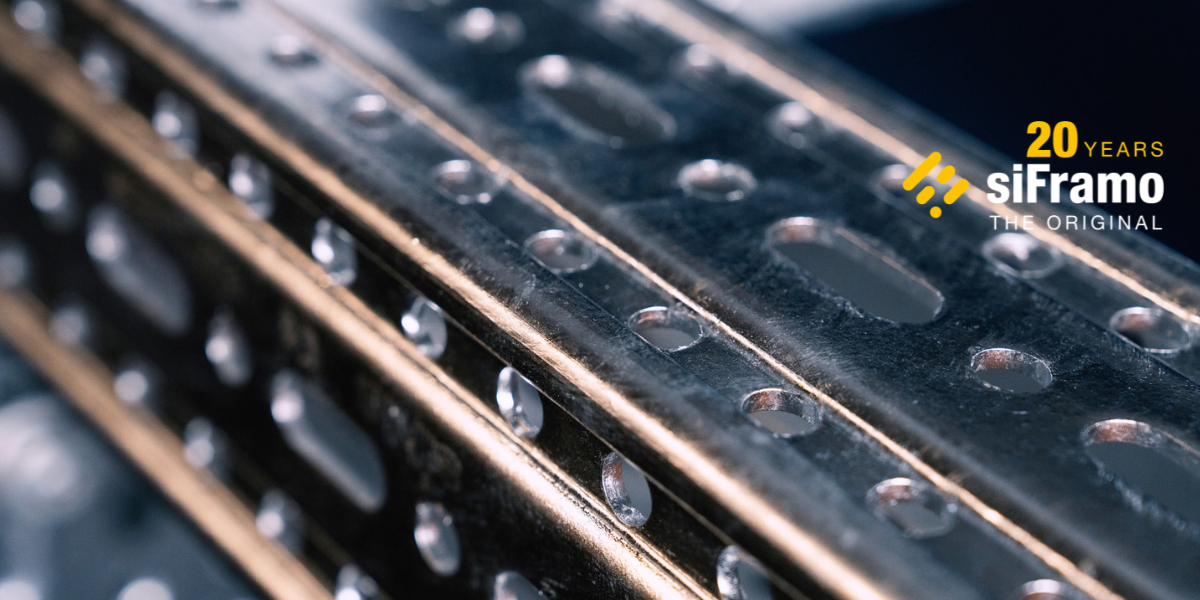
In 2006, Sikla revolutionised structural frame construction with the introduction of siFramo. An innovative modular support system built on self-forming screws, known as ‘One-screw technology.’ Combining high load-bearing capabilities with fast assembly, siFramo became an alternative to traditional welded steel to transform the way support systems are designed and installed.
Today, the challenges faced in industrial construction continue to evolve but the principles that shaped siFramo remain as relevant as ever. Developed to simplify installation, increase flexibility and improve efficiency on-site, the modular system continues to support complex projects around the world.
To mark siFramo's 20th anniversary, we interviewed two key figures involved in the systems development in our latest magazine, Clemens Warkus and Udo Bauer. They share their story behind siFramo's development, the challenges faced during the introduction, scepticism encountered and the factors that made siFramo a success.
What specific challenge was the starting point for the development of siFramo?
C. Warkus: The starting point was the search for an alternative to traditional welded support systems. The aim was to bridge the structural gap between steel beams and channel systems while also moving beyond the traditional two-dimensional approach.
What was siFramo intended to do differently compared with existing solutions?
C. Warkus: In short, everything. The move into a third dimension required a completely new, symmetrical structure. At the same time, it was important to ensure that adjacent components and surrounding areas were not affected. Another key objective was to reduce the number of individual parts required. The result was the idea of a modular system, or, to put it simply, a construction kit for “big boys”.
How long did it take for the idea to be ready for the market?
C. Warkus: The basic idea emerged surprisingly quickly from an experiment over the course of a few days. When the company founder, Sighart Klauß, saw it during his weekly walk through, he was so enthusiastic that he immediately decided: “Mr Warkus, we are going to do this.” The subsequent development and refinement process took several months before the system was ready for the market.
Looking back, which phase of development was the most challenging?
C. Warkus: Without a doubt, the prototyping phase. The technical implementation was particularly demanding. It involved profile manufacturing, structural testing of screw connections and load-bearing tests of the resulting structures.
What were the reactions when siFramo was first presented internally?
C. Warkus: At first, as is often the case with new innovations, scepticism and uncertainty dominated. Many questioned how a simple thread-forming screw connection without a lock nut, combined with a lighter profile featuring a welded seam, could replace a heavy steel beam. There were also concerns about the safety of the screw. The possibilities and advantages of siFramo were only recognised over time.
How do innovations, like this, come about?
C. Warkus: Innovation does not happen by chance. It starts with understanding the customer’s problem. A system or product is only successful if the people who use it are convinced and satisfied of its benefits. Curiosity and an open mind are essential. Inspiration can be found anywhere in nature, existing solutions or even in construction toys such as Meccano. A good developer understands not only technology, but also how purchasing, quality assurance and sales work.
Why was siFramo initially introduced for the industrial and plant engineering sectors?
U. Bauer: The target market for this business segment was industrial and plant engineering. This is where the product requirements were defined. Close and trusted customer relationships, particularly with investors in the chemical and pharmaceutical industries, were key drivers of its development and success. The close collaboration between customers, Sikla sales team and the development team enabled the quick development of a practical solution.
What concerns or objections were raised about siFramo in the early days?
U. Bauer: The screw connection was the biggest challenge from a sales perspective. While thread-forming screws were already established in the automotive industry, within plant engineering a screw connection without a lock nut was met with scepticism. Today, ‘One Screw Technology’ is regarded as a defining feature of modular support systems. Another concern was the large number of holes in the profile. However, these concerns quickly disappeared once the benefits of the stepless connection enabled by the offset hole pattern became clear.
Were there market requirements that influenced the further development of the system?
U. Bauer: The advantages of a modular support system compared with traditional welded steel structures were quickly recognised. As a result, demand for higher load-bearing capacities emerged early on. Expanding the profile range to include the 100 and 100/160 variants was not only essential for existing applications but became a key factor in entering new market segments and opportunities.
From your perspective, what were the key success factors?
U. Bauer: Key factors included requirements such as fast-track project delivery, shorter time-to-market requirements and a shortage of qualified labour. This is where siFramo provided a solution. It also became clear that the product system is only one part of a tailored solution. Software applications, extended engineering services, tailored manufacturing and logistic concepts, prefabrication options and supporting construction management are all essential elements of an end-to-end process. Our IPC strategy supports customers with solutions tailored to their specific industry project requirements. However, the most important factor in our success remains the people at Sikla who make all the difference.
A final thought that resonates behind 20 years of siFramo are the people who continue to contribute to its success everyday with commitment, conviction and passion.
Written by Sikla UK Oceania


Comments